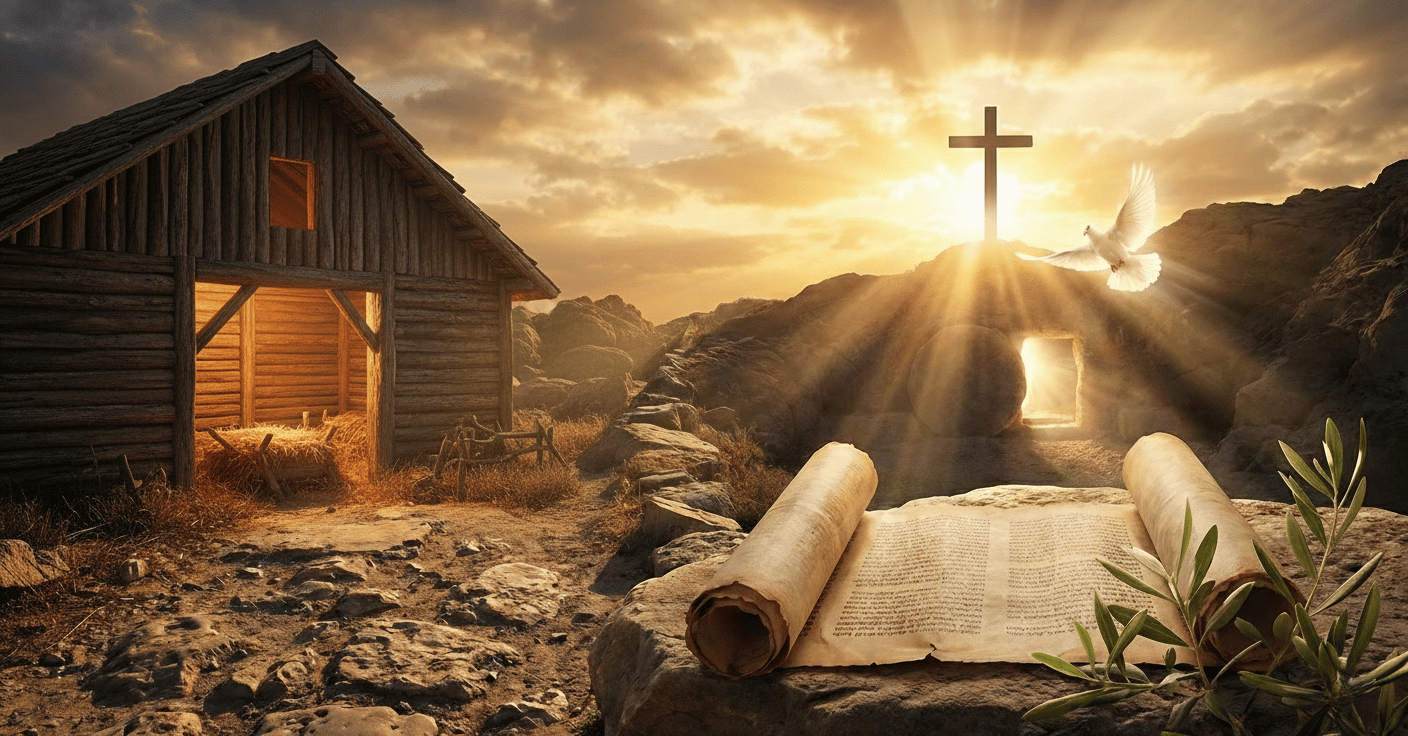

“Who am I?” must be answered from Scripture – first in Adam, then in Christ. The Gospel gives a sober diagnosis and a glorious new identity, summed up in the old Reformation phrase simul iustus et peccator – at the same time righteous in Christ and still a sinner in ourselves.
Who Am I by Nature?
- Created in God’s image
God made humanity “in His own image” and “after His likeness,” setting man apart from the rest of creation with real dignity and responsibility (Genesis 1:26–27; 2:7). You were created to reflect His character, live under His rule, and enjoy fellowship with Him. - Fallen in Adam and under wrath
Through Adam, sin and death entered the world, and so death spread to all because all sinned (Romans 5:12). Paul says that apart from Christ we are “by nature children of wrath, like the rest of mankind” (Ephesians 2:1–3). By nature, “Who am I?” is answered like this: a sinner, spiritually dead, guilty before a holy God. - Frail and fleeting
Scripture describes human life as grass that withers and a flower that fades (Isaiah 40:6–8), and as a mist that appears for a little time and then vanishes (James 4:14). Songs like Rusty Goodman’s “Who Am I?” and Casting Crowns’ “Who Am I?” tap into that same truth – a small, brief life before the eternal God, yet somehow noticed and loved.
So by nature you can say:
- I am made by God and accountable to Him.
- I am fallen in Adam, a sinner under His just wrath.
- I am a fragile, fleeting creature who cannot save myself.
Who Am I in Light of the Cross?
The cross shows both the depth of your ruin and the height of God’s love.
- God’s wrath “is revealed from heaven against all ungodliness and unrighteousness of men” (Romans 1:18). Sin is so serious that only the death of the Son of God could satisfy divine justice.
- Yet God “shows his love for us in that while we were yet sinners, Christ died for us” (Romans 5:8). The Righteous One suffered in the place of the unrighteous to bring us to God (1 Peter 3:18).
This is the biblical heartbeat behind those “Who Am I?” songs: the Psalm 8 and 2 Samuel 7 question – “What is man that you are mindful of him?” and “Who am I, O Lord God, that you have brought me this far?” – now answered at the foot of the cross.
Who Am I in Christ?
For those who repent and believe, Scripture gives a new, objective identity in union with Christ.
Classical Protestant theology summarizes this with the Latin phrase simul iustus et peccator – at the same time righteous in Christ and still a sinner in ourselves. Your remaining sin is real, but it is no longer your defining status before God.
- Justified
“Therefore being justified by faith, we have peace with God through our Lord Jesus Christ” (Romans 5:1). God declares the believer righteous, not because of works, but because Christ’s obedience and atoning death are counted to them. - A new creation
“If any man be in Christ, he is a new creature: old things are passed away; behold, all things are become new” (2 Corinthians 5:17). You are no longer only what you were in Adam; God has begun a real, inward renewal by His Spirit. - Adopted into God’s family
Those who receive Christ and believe in His name are given the right to become children of God, born of God (John 1:12–13). Romans 8:15–17 says believers have received the Spirit of adoption and cry, “Abba, Father,” as heirs with Christ. - Bought with a price, not your own
Paul reminds believers, “Ye are not your own. For ye are bought with a price: therefore glorify God in your body” (1 Corinthians 6:19–20). Your body is a temple of the Holy Spirit; your whole self belongs to the Lord who purchased you with Christ’s blood.
In Christ, you can now answer:
- I am a justified sinner, clothed in Christ’s righteousness.
- I am an adopted child of God, able to call Him Father.
- I am a new creation, no longer defined by my old life in Adam.
- I am not my own; I was bought with a price and belong to Him.
From Identity Crisis to Worship
When Scripture answers “Who am I?”, it moves you from self-preoccupation to worship.
- Looking at creation, you confess: I am made in God’s image for His glory.
- Looking at sin, you admit: I am the kind of person Romans 3 and Ephesians 2 describe – a sinner who truly needed a Savior.
- Looking at the cross, you marvel: I am someone so guilty that Christ had to die, and so loved that He was willing to die.
- Looking at your new status, you rejoice: I am simul iustus et peccator – still battling sin, yet already counted righteous, adopted, and made new in Christ.
Rusty Goodman’s and Casting Crowns’ “Who Am I?” both resonate with that story: a once-condemned, now-redeemed sinner asking why the King of glory would know, love, and lay down His life for someone so small and so flawed.
So the final turn of the question is really this: not only “Who am I?” but “Whose am I?” Outside of Christ, Scripture says you remain in your sins and under wrath. In Christ, you can say with full biblical warrant:
“I am His, and He is mine.”
Discover more from Real Josh Summers
Subscribe to get the latest posts sent to your email.