Part 1 of 3 in the Gospel Response Trilogy.
“Repent and believe in the gospel.” [Mark 1:15]
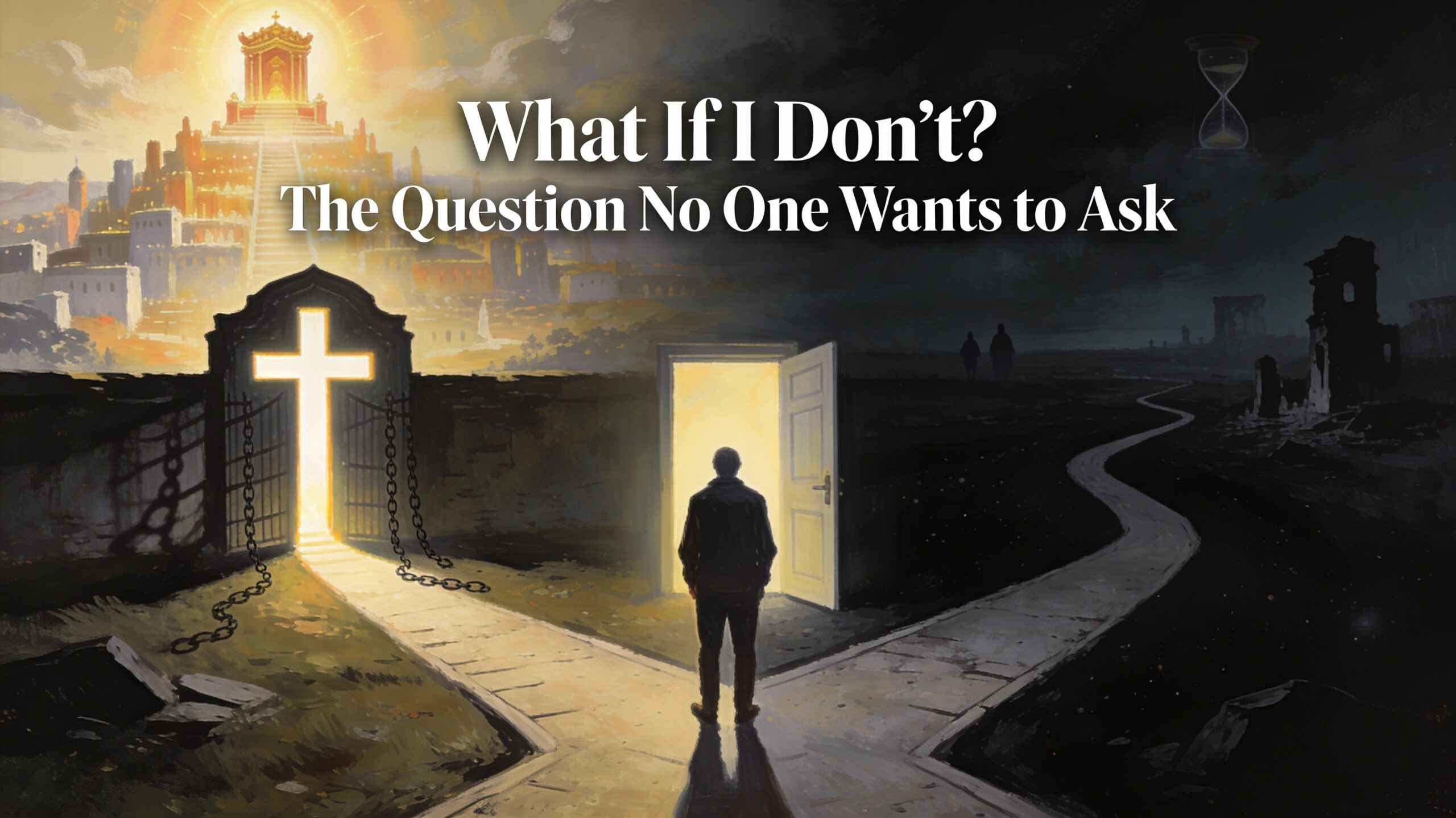
To repent and believe gospel is the command Jesus gives us in Mark 1:15. What If I Don’t Repent and Believe Gospel? Eternal Consequences. Let’s explore what happens if you don’t repent and believe gospel. This is part 1 of the Gospel Response Trilogy examines judgment, hell, and the eternal consequences of rejecting Christ’s call to repentance. To repent and believe the gospel is the command Jesus gives us in Mark 1:15. This summons from Jesus is unavoidable. He does not present it as one option among many. He presents it as a command, as THE doorway into life, as the only escape from coming wrath. Yet the question it raises terrifies us: What if I don’t?
“He who justifies the wicked and he who condemns the righteous are both alike an abomination to the Lord.”
If God calls it an abomination – something morally monstrous – to justify the guilty without justice, then indifference to the Gospel cannot be neutral. To remain in unbelief is not harmless. It is catastrophic.
The Objection Everyone Makes
Before we trace out what happens if you don’t repent and believe, let’s face the objections head-on. Because these objections keep people stuck in delay, and delay, spiritually speaking, is a decision.
“Isn’t God too loving to judge?”
This objection assumes love means indulgence—a sentimental, soft love that never confronts evil, never sets boundaries, never says no. But God’s love is not shallow sentimentality. It is holy love. His justice is not harsh arbitrariness; it is loving justice. These are not in competition; they are inseparable attributes of the same God.
Imagine a human judge who refuses to punish abusers or murderers because “he’s a loving judge.” We would call that corruption, not compassion. We would say that judge has betrayed the very people he should protect. Now consider: how much more must an infinite, holy God regard injustice as intolerable?
The cross itself proves this. If God were the sentimental judge many imagine, He would never have let His Son die. The agony of Gethsemane, the whip at Golgotha, the cry of dereliction from the cross—all of it would have been unnecessary theater. Instead, the cross reveals that God’s love is so serious, so real, that it will not compromise with sin. It must either destroy the sin or (at infinite cost) redeem the sinner through substitution.
“What about good, sincere people?”
Yes, there are people who live as good neighbors, devoted parents, generous friends. They pay their taxes, love their children, volunteer at shelters. We call this common grace—goodness that flows to all people whether they believe or not. But here is what breaks the logic of this objection:
Sincerity does not erase guilt. Good works do not satisfy justice.
Romans 3:23 says flatly: “None is righteous, no, not one… all have sinned and fall short of the glory of God.” The real divide is not “good people vs. bad people.” It is “in Adam vs. in Christ.”
By nature—by birth into the human race through Adam—every person is “a child of wrath” [Eph 2:3]. Even our best deeds are mixed with self-interest, shadowed by pride, and stained by the absence of what they should be: love for God above all. Without Christ, we remain under condemnation, and our good deeds cannot undo that fundamental condition.
“Isn’t hell an overreaction?”
It seems disproportionate: finite humans living 70 or 80 years, then eternal punishment? How could that be just?
But the seriousness of sin is not measured by the sinner’s duration or limitations. It is measured by the worth of the One sinned against. Rebellion against an infinite, holy, self-existent God carries infinite weight. To mock Him is far worse than to mock a human. To break His law is far worse than to break a neighbor’s rule.
If sin against God were a light matter, the crucifixion would be grotesque—God’s Son tortured and killed for nothing that really mattered. But if sin is infinite in its offense, then either the offender must experience infinite punishment (hell) or an infinite substitute must experience it (the cross). The cross exists because God refuses to do what Proverbs 17:15 forbids: justify the wicked without justice.
Scripture describes hell in unflinching terms: outer darkness, weeping and gnashing of teeth, the worm that does not die, the fire that is not quenched, conscious awareness of separation from God, and—most significantly—eternal duration. The Westminster Confession says the wicked “remain in torments and utter darkness” and are “punished with unspeakable torments, both of body and soul, with the devil and his angels for ever.”
These are not cartoon exaggerations. They are pictures of real, horrific, irreversible loss.
Already Condemned
Here is a fact most people have never truly absorbed: You are not condemned because you will eventually reject Christ. You are already condemned if you have not believed in Him.
John 3:18 states it plainly:
“Whoever believes in him is not condemned, but whoever does not believe stands condemned already, because he has not believed in the name of the only Son of God.”
This is stunning. The judgment is not future only; it is present. If you are outside of Christ right now, God’s verdict is already rendered: guilty. Not “guilty if you keep refusing,” but guilty already.
Why? Because you were born in Adam—born into sin, born under the law, born separated from God. The sentence is not a new thing being imposed if you reject Christ; it is already in effect. What Christ offers is not a prison sentence reduced if you’re good; He offers escape, a reprieve, a transfer from the kingdom of darkness to the kingdom of light.
To refuse that offer is not to stay neutral. It is to remain in the cell, to choose to ignore the door of escape standing open.

The Trajectory of Life Without Christ
What does it look like, spiritually, to say “What if I don’t” and mean it—to live without repenting and believing?
It rarely looks like shaking your fist at God or blaspheming openly. Much more often, it looks like:
- Delay: “I’ll think about it later.” “Later” becomes next year, becomes middle age, becomes a deathbed with no time left.
- Distraction: The cares of the world, the deceitfulness of riches, pleasures and entertainment so absorb the heart that God becomes a background whisper, never central. [Luke 8:14]
- Hardening: Romans 1:24–28 describes a process in which God “gives people over” to their desires. Each refusal of light hardens the heart. Each suppression of conscience makes the next suppression easier. A Christ-less life does not drift toward Him; it drifts away, getting harder and harder to hear His voice.
- False security: Building a life on achievement, family, health, hobbies, causes—all good things in their place—but without Christ as foundation. These become idols, and when they fail (as all earthly things do), there is nothing beneath.
The person living “What if I don’t?” lives as if he has infinite time, as if the word can be deferred, as if a single life is long enough to find his own way, his own meaning, his own righteousness.
Scripture warns sharply: You do not have infinite time.
The Appointment Only One Time
Hebrews 9:27 closes the door on reincarnation, second chances, or endless chances:
“It is appointed for man to die once, and after that comes judgment.”
One life. One death. One judgment.
No reincarnation. No purgatory. No “we’ll figure it out later.” The sequence is irrevocable: life → death → judgment. And that judgment concerns whether you are in Christ or in Adam, whether you have believed the gospel or rejected it.
Imagine standing before God on that day—not as an abstract thought, but as a real meeting. The veil between visible and invisible is torn away. You meet the Judge, the One against whom you have lived in rebellion or indifference or unbelief.
At that moment, two outcomes are possible:
Option 1: You are in Christ. His righteousness is your covering. His blood has satisfied justice on your behalf. The Judge who sentences you is also your Mediator, your Redeemer, your Brother. You hear, “Well done, good and faithful servant. Enter into the joy of your Lord.” [Matt 25:21]
Option 2: You stand alone in your sin. There is no substitute, no mediator, no escape. The Judge is infinitely holy, and you are infinitely guilty. Justice must be satisfied. There is no one to pay the debt for you.
What If I Don’t? The Answer
Hell is the answer to “What if I don’t?”
It is not mythology. It is not metaphor. It is the eternal, conscious punishment of those who refused Christ. It is the experience of God’s righteous wrath—not His arbitrary rage, but His perfect, holy opposition to sin.
Revelation 14:10–11 describes it: “If anyone worships the beast and its image… they will drink the wine of God’s wrath, poured full strength into the cup of his anger… And the smoke of their torment rises forever and ever.”
John 3:36 says: “Whoever does not obey the Son shall not see life, but the wrath of God remains on him.”

2 Thessalonians 1:8–9: Those “who do not know God and on those who do not obey the gospel of our Lord Jesus… will suffer the punishment of eternal destruction, away from the presence of the Lord and from the glory of his might.”
Hell is not an accident, not a failure of love, not an overreaction. It is the rightful consequence of rejecting the only way of salvation. It is what happens when a person meets a holy God without a mediator, when sin meets justice without a substitute.
And the tragedy is not only the pain of hell. It is the loss—the loss of Christ Himself, the God you were made for, the joy you were designed to experience, the glory that could have filled your eternal soul. To spend eternity without Christ is to spend it without the only thing that ever truly satisfies.
The Most Urgent Question
So ask yourself right now: Am I truly believing the gospel, or am I in “What if I don’t?” mode—delaying, distracting, hardening my heart?
Because one day, one of two things will be true of you:
- You will have repented and believed, and you will meet God as a beloved child.
- You will not have, and you will meet God as a rebel.
There is no third option. There is no neutral ground. The question is not whether you will choose. The question is which choice you will own.
“What if I don’t?” cannot be asked casually. It is a serious question with an eternal answer.
But there is a “What if I do?”—and we’ll explore that next.
Discover more from Real Josh Summers
Subscribe to get the latest posts sent to your email.