
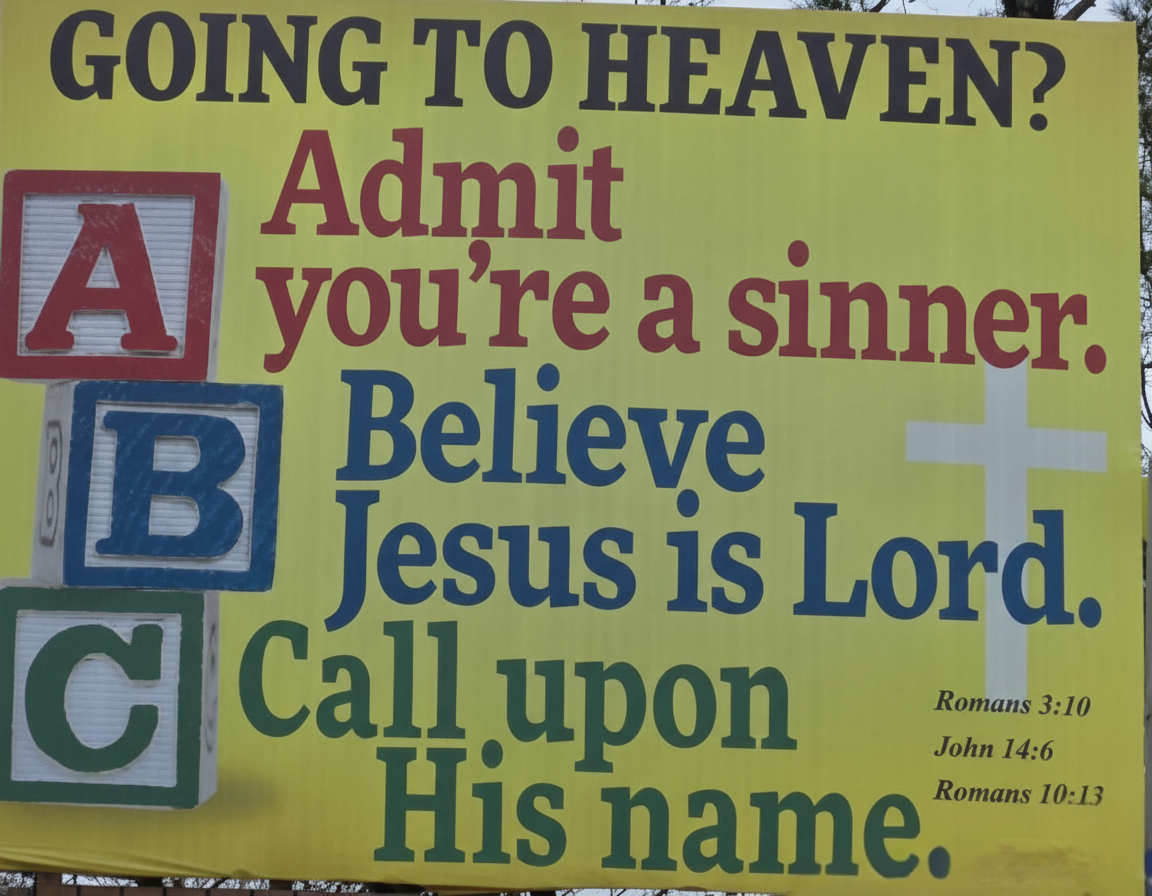
On this Christmas Day, as candlelight flickers in churches around the world and families gather beneath trees adorned with lights, we pause to remember the birth of our Savior. What kind of gospel did that Child in the manger actually bring? Was it a new formula to follow—a spiritual checklist of steps we must master or was it the arrival of salvation itself, complete and unmerited grace for all who would believe in Christ? For centuries, the Church has contemplated this mystery, and today it speaks with special clarity against the backdrop of every formulaic gospel presentation that reduces divine mystery to human mechanics.
Modern evangelicalism often distills the good news into the “ABCs of salvation”: Admit you are a sinner, Believe on Jesus, and Confess your sins. On the surface, these resonate with Scripture; Romans 3:23 acknowledges universal sinfulness, John 3:16 proclaims belief in Christ, Romans 10:9 speaks of confession. Yet when packaged as a rigid three-step sequence that the sinner must execute perfectly to trigger God’s response, they subtly shift the gospel from divine gift to human performance. The sinner becomes the active agent, the one whose sincerity and accuracy determine salvation. This creates a new legalism, more psychological than ceremonial, but no less burdensome than the old covenant works. Assurance becomes tethered not to Christ’s finished work but to the fragile memory and sincerity of “that prayer I prayed years ago.”
Alongside the ABCs thrives another staple of modern evangelism: the “Roman Road“, which chains five select verses from Paul’s epistle to the Romans – 3:23, 6:23, 5:8, 10:9-10, and 10:13 – into what proponents call an efficient salvation summary. The script goes: Admit your sin (3:23), understand the penalty (6:23), grasp God’s love (5:8), confess and believe (10:9-10), call on the Lord (10:13). Evangelism tracts and altar calls present this as a foolproof path to heaven. Yet both the ABCs and Roman Road exemplify the same fundamental error: formulas that, however biblically sourced, wring the truth from context and transform God’s sovereign accomplishment into human checklists.
“Unto you is born this day in the city of David a Savior, who is Christ the Lord”
(Luke 2:11)
Salvation is not a system we apply but a Savior who applies Himself to us. Christmas confronts every formula with this reality: the gospel begins in a cradle of divine initiative, not a classroom of human steps.
The Trap of Decisional Regeneration — and the Roman Road Detour
The ABCs, though well-intentioned, quietly convert living faith into mechanical self-effort – a decision sinners muster rather than a miracle God sovereignly performs. Theologians have long termed this distortion decisional regeneration: the belief that new spiritual birth hinges on the sinner’s correct act of will rather than God’s preceding, enabling grace. Human sincerity becomes elevated above divine power. Assurance shifts from Christ’s objective accomplishment to subjective introspection: “Was my confession sincere enough? Did I believe hard enough?” The believer trades rest in the gospel promise for anxious auditing of personal performance.
Martin Luther exposed this peril with surgical precision in his *Bondage of the Will*, confronting Erasmus’s semi-Pelagian optimism:
“Whilst a man is persuaded that he has it in his power to contribute anything, be it ever so little, to his salvation, he remains in carnal self-confidence; he is not a self-despairer, and therefore is not duly humbled before God.”
Luther understood the human heart’s deceitfulness; we crave a salvation we can measure, control, and claim as our own achievement.
Equally problematic – and far more pervasive – is the “Roman Road”, that modern evangelism staple stringing Romans 3:23, 6:23, 5:8, 10:9-10, and 10:13 into what appears a tidy salvation path. Evangelists present it as streamlined gospel efficiency: problem (sin), bad news (death), good news (love), solution (confess/believe/call). Tracts fold neatly into pockets; counselors memorize the sequence. Yet this approach catastrophically rips these verses from Romans’ majestic theological architecture. Paul’s epistle unfolds systematically: chapters 1-3 hammer universal guilt under divine law; 4-8 expound justification by Christ’s imputed obedience alone; 9-11 address God’s sovereign election of Israel; 12-16 apply this doctrine to Spirit-empowered living. Decontextualized and reordered, these texts transmute into a transactional script: “Do these steps correctly, and salvation activates.” This precisely mirrors the Galatian heresy Paul thundered against—
Having begun by the Spirit, are you now being perfected bythe flesh? Galatians 3:3
Human invention combined with a splash of spiritual sounding ‘incantation’ called the “Sinner’s Prayer” does not create Christians. It does not result in saving faith. What it does create, however, are false converts who constantly doubt their own salvation, then when the winds come, their house falls because it is not built upon the Rock – it is built upon the sand.
Dissecting the Roman Road: Verse by Verse
Romans 3:23
“For all have sinned and fall short of the glory of God.” Evangelists wield this as a gentle opener: “Nobody’s perfect; we all miss the mark.” Isolated from context, it softens total depravity into mere imperfection, suggesting sinners retain capacity for moral improvement. Yet Romans 3:9-20 crushes all such optimism with Old Testament thunder: “None is righteous, no, not one; no one understands; no one seeks for God. All have turned aside… no one does good, not even one” (Psalm 14:1-3; 53:1-3). The law “stops every mouth” and holds the world “accountable to God” (3:19). Verse 23 crescendos this divine indictment, thrusting sinners beneath wrath (1:18; 2:5). This launches no human initiative but demands total dependence on Christ’s propitiation immediately following (3:25).
Romans 6:23
“The wages of sin is death, but the free gift of God is eternal life in Christ Jesus our Lord.” Sounds like a straightforward choice: death or life? Yet chapter 6 addresses *already regenerate believers* united with Christ in His death and resurrection (6:3-11), urging them to “reckon” this reality true and live accordingly. “Wages” evokes Israel’s covenant curses (Deuteronomy 28); death means eternal separation under justice (1:32). Dead sinners cannot “choose life” any more than Lazarus summoned himself from the tomb before Christ’s sovereign call (John 11:43). The “free gift” references Christ’s active obedience credited through union, not a decisionist’s voucher activated by reciting words.
Romans 5:8
“God shows his love for us in that while we were still sinners, Christ died for us.” Isolated, this fuels sentimental universalism: “God loves everybody—just believe!” Yet chapter 5 contrasts Adam’s federal headship (death to all humanity) with Christ’s (righteousness and life to His elect, 5:12-21). Christ’s death constitutes particular redemption for “the ungodly” God justifies freely “by his grace through the redemption that is in Christ Jesus” (3:24-25). This demonstrates electing love, not general benevolence awaiting human response.
Romans 10:9-10
“If you confess with your mouth that Jesus is Lord and believe in your heart that God raised him from the dead, you will be saved.” The Road’s dramatic climax, presented as simple causation. Utterly catastrophic decontextualization. Romans 10 confronts Israel’s unbelief despite privileges (9:30-10:4), contrasting Gentile faith with Jewish zeal “not according to knowledge” (10:2). True confession flows from Spirit-wrought conviction—”No one can say ‘Jesus is Lord’ except in the Holy Spirit” (1 Corinthians 12:3). “Faith comes from hearing… the word of Christ” preached (10:17), quoting Deuteronomy 30 and Isaiah 28:16. The Road inverts this: confession/belief become preconditions rather than fruit of regeneration.
Romans 10:13
“Everyone who calls on the name of the Lord will be saved.” Inviting altar call finale. Yet Joel 2:32’s quote caps a missiological chain: ambassadors sent, gospel preached, sinners awakened, then calling (10:14-17). “It does not depend on human will or exertion, but on God who has mercy” (9:16). The Road manufactures false assurance through mechanical recitation.
No verse chain “magically” births Christians; only the Spirit wielding Scripture’s full counsel does (John 3:8). The first Christmas obliterates every formula: shepherds tending sheep in darkness, suddenly engulfed by divine glory (Luke 2:9); Magi guided by a star God sovereignly positioned; Mary receiving Gabriel’s impossible announcement rather than initiating incarnation (Luke 1:35). **Every character was gloriously interrupted by grace.** Salvation originates in God’s condescending descent, never human ascent.
The Incarnation: Grace in Flesh, Not a Formula
When “the Word became flesh and dwelt among us” (John 1:14), He forever dismantled transactional, formulaic faith. The newborn Christ arrived not to dispense improved acronyms or Roman Road maps but to *become* our righteousness (2 Corinthians 5:21), our substitute beneath divine wrath, our very life breathed into spiritually dead bones. Manger straw already foreshadowed Golgotha’s blood-soaked splinters; swaddling cloths hinted at burial linens soon vacated by resurrection power.
Picture the scene: rough Galilean shepherds crowding a Judean stable, pagan Persian Magi bearing incongruous royal gifts, bewildered teenage parents cradling the Creator. No one recited scripted confessions. No verse chains activated salvation. Yet “the true light, which gives light to everyone, was coming into the world” (John 1:9). When evangelicals reduce the gospel to performance humans must perfect—checking ABC boxes, walking Roman Roads—they miss Christmas’s staggering, humiliating glory: **the performance was never ours to perfect.** God invaded humanity precisely because self-perfection proved impossible. The angels’ midnight proclamation to terrified shepherds crystallized this: “Fear not, for behold, I bring you good news of great joy that will be for all the people. For unto you is born this day in the city of David a Savior, who is Christ the Lord” (Luke 2:10-11). Notice the grammar: joy comes *to* recipients, not earned *by* performers. Advent thunders divine intervention into human impossibility, not human initiative meriting divine favor. The Incarnation declares every formula bankrupt; the God-man has fulfilled every righteous requirement on our behalf.
Reformed Voices Echo Bethlehem’s Cry
Seventeenth-century Particular Baptists confessed precisely what Bethlehem rendered visible to the world: humanity’s total inability to initiate reconciliation with God. The Second London Baptist Confession (1689, Chapter 9, “Of Free Will”) states this unequivocally:
“Man, by his fall into a state of sin, hath wholly lost all ability of will to any spiritual good accompanying salvation; so as a natural man, being altogether averse from that good, and dead in trespasses and sins, is not able by his own strength to convert himself, or to prepare himself thereunto.”
This echoes Paul’s devastating diagnosis:
“And you were dead in the trespasses and sins” (Ephesians 2:1).
This Bethlehem infant constitutes no mere moral exemplar demanding imitation but grace incarnate—Emmanuel, “God with us” (Matthew 1:23) – precisely because fallen humanity proved incapable of ascending to God. Bethlehem loudly proclaims this: Heaven condescends because man cannot climb.
From Manger to Cross to Empty Tomb
Advent’s hushed anticipation inevitably marches beyond Bethlehem’s cradle to Calvary’s cross and the radiant empty tomb. The holy Child’s earthly trajectory stood eternally fixed: from manger humility through public ministry to crucifixion’s agony to resurrection triumph. Romans 4:25 crystallizes the progression: Christ “was delivered up for our trespasses and raised for our justification.” Swaddling cloths yielded to Roman scourging, naked cross exposure, burial linens—then glorious vacancy declaring victory over death, sin, Satan, and condemnation.
This constitutes no mere historical sequence but God’s cosmic accomplishment that sovereignly births eternal life within spiritually dead sinners (Ephesians 2:5). Just as angelic light shattered the shepherds’ midnight vigil, resurrection grace shatters humanity’s moral and spiritual darkness: “For God, who said, ‘Let light shine out of darkness,’ has shone in our hearts to give the light of the knowledge of the glory of God in the face of Jesus Christ” (2 Corinthians 4:6). Salvation cascades not from human sincerity straining upward but from Christ’s resurrection glory condescending downward in conquering power. The empty tomb validates every cradle carol sung through centuries: what commenced in Bethlehem’s obscurity culminated in irreversible, universe-shattering victory.
Resting in the Finished Work—The True Joy of Christmas
The newborn Christ descended not to give us improved ABCs or Roman Road maps but to constitute salvation itself. Ezekiel 36:26 unveils the New Covenant’s essence:
“And I will give you a new heart, and a new spirit I will put within you. And I will remove the heart of stone from your flesh and give you a heart of flesh.”
Christmas incarnates this miracle: divine heart surgery upon an unwilling, stony, rebellious people – not checklists dutifully fulfilled by human willpower.

Abandoning formulaic bondage for Christ’s living reality brings profound freedom. Salvation’s crushing burden lifts from the seeker’s faltering sincerity (which ultimately will fail, leading to uncertainty in salvation) to the Savior’s flawless sufficiency (which ultimately rests on the promises of God, leading to assurance of salvation). Bethlehem’s infant bore redemption’s weight long before staggering beneath Calvary’s crossbeams; that cross sent him Him to Joseph’s tomb where every divine promise sealed eternally and justifying faith secured immovably.
Christians rejoice this sacred day, not by rehearsing personal decisions—”that altar call when I finally got it right”—but by beholding His decisive, history-altering acts: incarnation’s humbling frailty, substitutionary death swallowing wrath, resurrection power vanquishing death. Manger, cross, and empty tomb weave one continuous tapestry of divine mercy, weaving incarnation into atonement into glorification.
Therefore “let us run with endurance the race that is set before us, looking to Jesus, the founder and perfecter of our faith, who for the joy that was set before him endured the cross, despising the shame, and is seated at the right hand of the throne of God”
Hebrews 12:1-2
Merry Christmas. Rest wholly in His finished work.
Discover more from Real Josh Summers
Subscribe to get the latest posts sent to your email.